In this article
March 17, 2026
-
13 min read
Best Returns Management Software for Ecommerce Brands in 2026


When a customer initiates a return, every second of delay and every point of friction has a measurable cost. Refund satisfaction, repeat purchase rate, and support ticket volume are all directly shaped by how smoothly the returns process runs. Yet for many ecommerce brands, "returns management" isn't one platform. It's three different systems, two vendor relationships, and a spreadsheet holding it together.
Returns get initiated through a branded portal. Package protection claims route through a separate provider. Exchange nudges either don't exist or are handled manually. Finance reconciles return-related accounting from exported CSV files. Every seam in that architecture creates operational drag: slower processing, duplicate data entry, reconciliation failures, and a customer experience that signals disorganization.
This fragmentation is a known, solved problem, but only if you're running on the right platform. The brands moving fastest on returns strategy in 2026 aren't adding more tools. They're consolidating onto platforms that handle the full lifecycle.
This guide evaluates the best returns management software available today, breaks down what separates commodity tools from genuinely differentiated platforms, and gives you the framework to make a confident buying decision.
Why Returns Management Software Is a Strategic Priority in 2026
The economics of ecommerce returns have changed. Return rates for online apparel average 20 to 30 percent. For luxury goods, they can exceed 40 percent. The cost of processing a single return, including labor, shipping, restocking, and lost resale value, ranges from $15 to over $30 depending on the category and how efficiently it's handled.
At those volumes and costs, returns management isn't an operational line item. It's a strategic function with direct margin impact. Signifyd's 2026 Ecommerce Trends Report describes ecommerce returns as a $260 billion-plus problem driven by a mix of consumer behavior and fraud, and identifies platforms that consolidate fraud prevention, exchange flows, and analytics into a single workflow as the strongest lever brands have to mitigate that pressure.
The platforms that brands used five years ago weren't built for this. First-generation returns tools were portals that generated labels and sent refund notifications. They did that one job reasonably well. But as brands scaled, those tools became bottlenecks: they couldn't handle multi-warehouse routing, they didn't support exchange conversion at meaningful scale, and they created finance reconciliation challenges because they weren't designed to integrate deeply with modern ERP systems.
The next generation of returns management software is built for operational complexity. The right platform handles fraud prevention, warehouse grading, instant exchanges, package protection, multi-channel order routing, and analytics in one place. The wrong platform is still just a portal.
What to Look for in Returns Management Software
The following capabilities define the difference between a returns portal and a returns platform. Use these as your evaluation criteria when comparing vendors.
End-to-end lifecycle coverage: Can the platform handle the complete flow, from customer-initiated return through label generation, inbound shipping tracking, warehouse receiving, item grading and condition verification, refund or exchange processing, and reporting, without handing off to another system? Every handoff is a potential failure point.
Exchange and store credit conversion tools: Returns don't have to mean lost revenue. The best platforms build exchange nudges directly into the customer-facing flow, incentivize store credit over cash refunds, and support instant exchanges, where the replacement order ships before the original item is received back. Brands that optimize this step see materially lower net return costs and stronger customer retention.
Configurable fraud detection: Return fraud is a growing problem, particularly for high-value products and luxury goods. Effective fraud prevention requires configurable rules by product type, price point, and customer history, not a binary on/off toggle. AI-assisted detection that continuously improves its accuracy on serial return patterns adds a layer that scales with transaction volume.
Multi-warehouse and 3PL routing: For brands operating more than one fulfillment location, or working with third-party logistics partners, return routing logic is a critical capability. Returns need to reach the correct facility based on origin, carrier, product category, or merchant-defined rules. Manual routing at scale is expensive and error-prone.
Integration quality: Surface-level integrations with Shopify, ERPs, and warehouse management systems create more problems than they solve. Look for native integrations that handle edge cases (bundles, multi-instance storefronts, exchange accounting, RMA generation) without requiring manual cleanup.
Analytics and reporting: Return rate by product and category, exchange conversion rate, return reason distribution, portal engagement metrics, and fraud detection rate are the data points that turn returns management from reactive to proactive. Look for platforms with customizable reporting, drilldown capability, and standardized filter naming.
Onboarding and support model: A platform with enterprise-grade capabilities and no onboarding support creates implementation risk. Lean teams especially need a white-glove setup process, documentation that covers edge cases, and responsive support post-launch.
The Top Returns Management Platforms Compared
Three platforms dominate the conversations we see when brands evaluate alternatives: Loop Returns, Happy Returns, and Returnly. Here is the honest read on each, and where Redo lands relative to all three.
Loop Returns. Strongest in branded portal experience and instant exchanges, with a deep Shopify integration that scales well for many DTC brands. Where it falls short: warehouse grading and verification, AI-assisted fraud detection, native package protection (Loop relies on Route as a separate vendor), and bundle and child SKU handling, which is manual. Multi-warehouse routing exists but is limited.
Happy Returns. Built around the drop-off network model, which is genuinely useful for brands whose customers value in-person return convenience. Outside that core, the platform skips exchange incentives, AI fraud detection, native package protection, multi-instance Shopify support, and TikTok Shop coverage. Multi-warehouse routing is limited to the drop-off network itself.
Returnly. Now part of Affirm. Offers instant exchanges through its Loop integration and a competent branded portal, but lacks native fraud detection, warehouse grading and verification, multi-warehouse routing, package protection, NetSuite RMA support, multi-instance Shopify, and TikTok Shop coverage. Bundle handling is basic.
Redo. The only platform on this list with full lifecycle coverage in a single system: native warehouse grading, AI-assisted fraud detection with a configurable rules engine, integrated package protection, multi-warehouse routing, deep NetSuite integration with auto-generated RMAs, multi-instance Shopify support, native TikTok Shop integration, automatic bundle and child SKU handling, drilldown analytics, and white-glove onboarding all built in.
For a deeper read on how these capabilities interact in practice, see our deep dive on returns software.
Redo: The All-in-One Returns Platform Built for Scale
Redo was designed from the ground up to solve the platform consolidation problem. Where competitors built a portal and added capabilities over time through acquisition and integration, Redo built a unified system where returns, package protection, warehouse operations, fraud prevention, and analytics share a single data model.
That architectural choice has practical consequences. When your returns data and your package protection claims data live in the same system, reconciliation is automatic. When your exchange conversion tools and your analytics share the same event stream, you can measure what's working and optimize without exporting to a spreadsheet. When your fraud detection rules engine has access to the full order and return history, its decisions are more accurate.
The Full Returns Lifecycle in One Platform
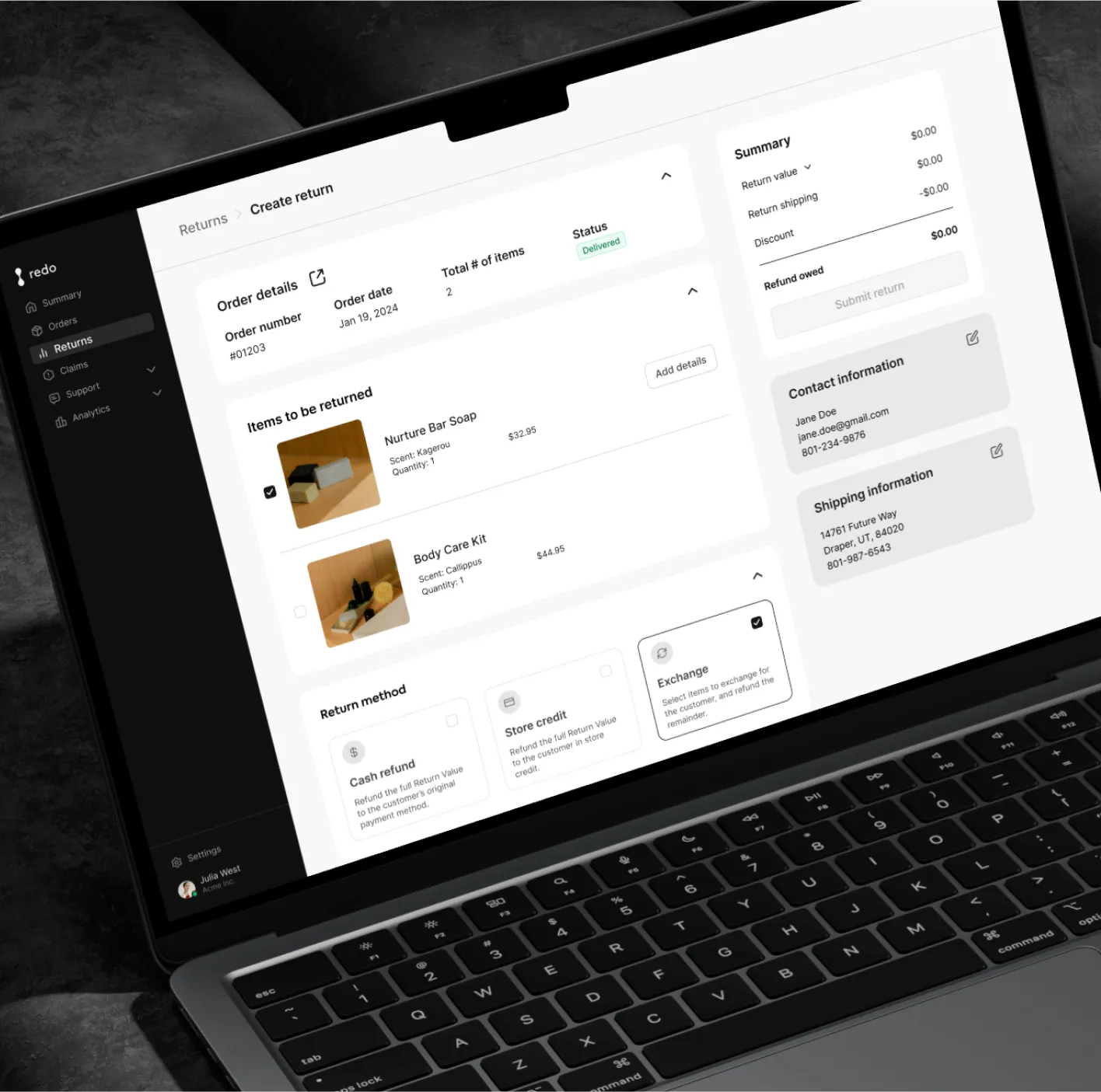
The returns flow in Redo starts the moment a customer opens the branded self-serve portal. The customer selects items to return and chooses a return method, with location-based routing logic that directs the return to the correct facility based on configurable conditions, including order creation date, product type, and return origin. This means merchants can automatically apply different return policies to orders placed during promotional windows or holiday periods without manual overrides.
The customer receives a return label generated using Redo's real-time rate calculation engine, which ensures accurate label cost accounting and eliminates discrepancies between estimated and actual shipping costs. Labels are generated at return initiation, meaning the financial data is available for accrual immediately.
At the warehouse, Redo's grading and verification flow gives staff a structured workflow to assess the condition of each returned item, assign a grade, verify item details, and route the item to the appropriate next step: refund, exchange, resale, or liquidation. A duplicate processing safeguard prevents staff from completing a return that has already been processed, protecting inventory accuracy and preventing double-refunds.
Refunds are processed with financial transparency: adjustments are displayed as separate line items rather than folded into the main refund amount, reducing disputes and creating cleaner accounting records. For NetSuite users, RMAs are auto-generated at return initiation, and store credit and refund amounts appear as separate line items in RMA records, eliminating the reconciliation failures that frequently occur with exchange transactions in platforms that weren't designed with ERP integration in mind.
Exchange Conversion: Turning Returns Into Retained Revenue
Redo's exchange tools are designed to shift the customer's default decision from refund to exchange. The redesigned item detail page within the exchange flow creates a polished selection experience that builds purchase confidence. Instant exchanges, where the new order ships before the return is received, remove the waiting period that makes refunds feel more attractive to customers on a timeline.
AI-powered chat suggestions surface the most relevant resolution option for each customer's situation, matching the return reason to the most appropriate exchange or credit offer. The skip-unnecessary-step optimization in the exchange flow reduces click fatigue for customers who've already decided to exchange, increasing completion rates on initiated exchanges. Merchants can configure exchange incentives, like a small discount or free shipping on the exchange order, to further improve conversion at the margin level that makes sense for their business.
Package Protection Without the Second Contract
Brands using one platform for returns and a separate provider for package protection are managing two vendor relationships, two billing cycles, and two datasets that don't natively communicate. Support teams are context-switching between portals. Finance is reconciling separate reports. Analytics are fragmented by design.
Redo consolidates both in a single platform, giving merchants unified visibility into return activity and protection claims without any stitching. When a customer files a claim for a lost or damaged shipment, it routes through the same workflow, the same analytics dashboard, and the same merchant-facing portal as a standard return. One platform. One dataset. One vendor relationship. Native package protection without the second contract.
Fraud Prevention That Scales With Your Business
Return fraud is a structural problem for high-value ecommerce brands. Luxury goods, electronics, and premium apparel face elevated risk because the return process is largely self-serve and the items have strong secondary market value. The challenge is preventing fraud without adding friction that degrades the experience for the vast majority of legitimate customers.
Redo's fraud prevention approach combines a configurable rules engine with AI-assisted serial return detection. The rules engine lets merchants set thresholds by price point and product type, with different rules for a $600 jacket than a $25 accessory, without maintaining separate workflows for each product category. Manual review flags route high-risk returns to a human decision-maker before processing completes, adding a checkpoint without slowing down the majority of legitimate returns.
The serial return fraud detection model runs continuously, with ongoing accuracy improvements that tighten the signal-to-noise ratio over time. As transaction volume grows, the model improves. As fraud patterns evolve, the rules engine can be updated without a development cycle. For a deeper walkthrough of how this works in practice, see our return fraud prevention guide.
Integration Depth: The Detail That Determines Operational Outcomes
Most returns platforms advertise integrations. Fewer of them hold up under the operational weight of a complex ecommerce business with multiple storefronts, an ERP, and a growing channel mix.
Multi-instance Shopify: Brands operating separate Shopify storefronts for different markets (US, Canada, EU) need unified returns management, not a separate portal configuration for each instance. Redo's multi-instance support handles this without requiring merchants to manage separate return policies, label configurations, or analytics per storefront.
Bundle and child SKU handling: Product catalog complexity is where shallow integrations break. Platforms that require manual import of bundle relationships and child SKU associations create ongoing data entry burden and introduce errors downstream in exchange availability, inventory, and analytics. Redo handles this automatically, with native product relationship imports that stay current as the catalog changes.
TikTok Shop: As TikTok Shop becomes a material sales channel for a growing number of ecommerce brands, returns management coverage matters. Redo's native TikTok integration routes TikTok orders into the same returns workflow as Shopify orders, giving merchants a unified view rather than a separate processing track that requires different tooling and different reporting.
Payment and refund UX: For merchants using ACH payment flows, improved UX around bank account verification and payment processing affects completion rates and support volume. Redo's ACH improvements reduce confusion during verification steps, decreasing the support contacts generated by payment-related issues in the returns flow.
What Switching Actually Looks Like
The most common objection to platform consolidation isn't dissatisfaction with the current solution. It's switching cost. Implementation effort, data migration, internal change management, and existing contract terms all factor into the timing decision. A realistic picture of that process makes the decision easier to evaluate.
Onboarding is a managed process, not a DIY setup. Redo provides white-glove onboarding and guided setup. The Customer Portal Preview Mode activates before a payment method is configured, letting merchants see and validate the full portal experience before going live. That means fewer configuration surprises at launch and a faster path to a polished customer-facing experience.
Catalog and routing setup is largely automated. Bundle and child SKU imports are handled automatically, removing the manual data entry that creates errors in systems with weaker product relationship handling. Warehouse routing rules, fraud configuration, and return policy logic are established during onboarding with Redo team support.
Multi-stakeholder approval processes are supported. For brands with layered approval processes, Redo provides ROI documentation, async demo resources, and materials designed to support internal evaluation without requiring a live demo for every decision-maker.
Contract timing is a planning input, not a blocker. Brands mid-contract with an existing provider don't need to act immediately. They need to know what they're moving toward. Evaluating Redo before a renewal window opens means the transition is planned rather than reactive, and the implementation is ready to start the day the contract turns over.
Turning Returns Into a Competitive Advantage
The brands that win on returns strategy in 2026 aren't just managing returns efficiently. They're using returns as a conversion and retention channel. Every return interaction is a touchpoint with a customer who already trusts the brand enough to buy from it. The software layer determines what happens with that moment. For a broader strategy view, our returns management guide covers the operational and CX choices that compound over time.
A platform that defaults to refund-only flows and basic analytics treats returns as cost containment. A platform with exchange conversion tools, AI-assisted resolution suggestions, fraud controls that protect margin without damaging customer relationships, and analytics that drive continuous optimization treats returns as a growth lever.
Redo is built on the second model. The data, the tooling, and the architecture are oriented toward turning returns activity into brand-building moments that retain customers and recover revenue that would otherwise walk out as a cash refund.
Ready to transform your returns experience? Book a demo and see how Redo helps merchants reduce costs, delight customers, and turn returns into revenue.
Key Insight
Returns management software has matured beyond the label-and-portal model. The platforms that matter in 2026 handle the full lifecycle (fraud prevention, warehouse operations, exchange conversion, multi-channel integration, and analytics) in one unified system. Brands running three tools stitched together aren't just overpaying. They're leaving revenue on the table and creating operational risk every time those tools fail to sync. Consolidation is the strategic move, and the cost of switching is lower than most brands expect.
About Redo
Redo helps ecommerce brands turn post-purchase moments into lasting relationships.
Use AI-powered return flows, exchange-first logic, instant credit, and analytics to understand not just what customers bought, but why they come back.