In this article
May 18, 2026
-
4 min read
What Is a Restocking Fee? A 2026 Guide for Ecommerce Brands


A restocking fee is a charge a retailer applies when a customer returns a product, deducted from the refund to cover the cost of inspecting, repackaging, and putting that item back into sellable inventory. It is usually a percentage of the item price, commonly in the 10% to 25% range, though some brands use a flat amount instead. The fee shows up most often on opened electronics, custom or made-to-order goods, large items, and final-sale categories where a return carries real reconditioning cost.
Why Restocking Fees Matter
For an ecommerce operator, a restocking fee is not really about the fee. It is about return economics. Every returned order has to be received, inspected, graded, repackaged, and either restocked or written off, and none of that work is free. Industry benchmarks put the cost of processing a single return at roughly $15 to $30 once labor, return shipping, and lost sellable value are counted. A restocking fee is one lever brands use to recover part of that cost and to slow down casual returns on items that are expensive to put back on the shelf.
The tradeoff is friction. A fee that protects margin can also be the exact reason a shopper does not come back. So the real question is never "should we charge a fee," it is "where does a fee recover genuine cost without quietly spending future revenue."
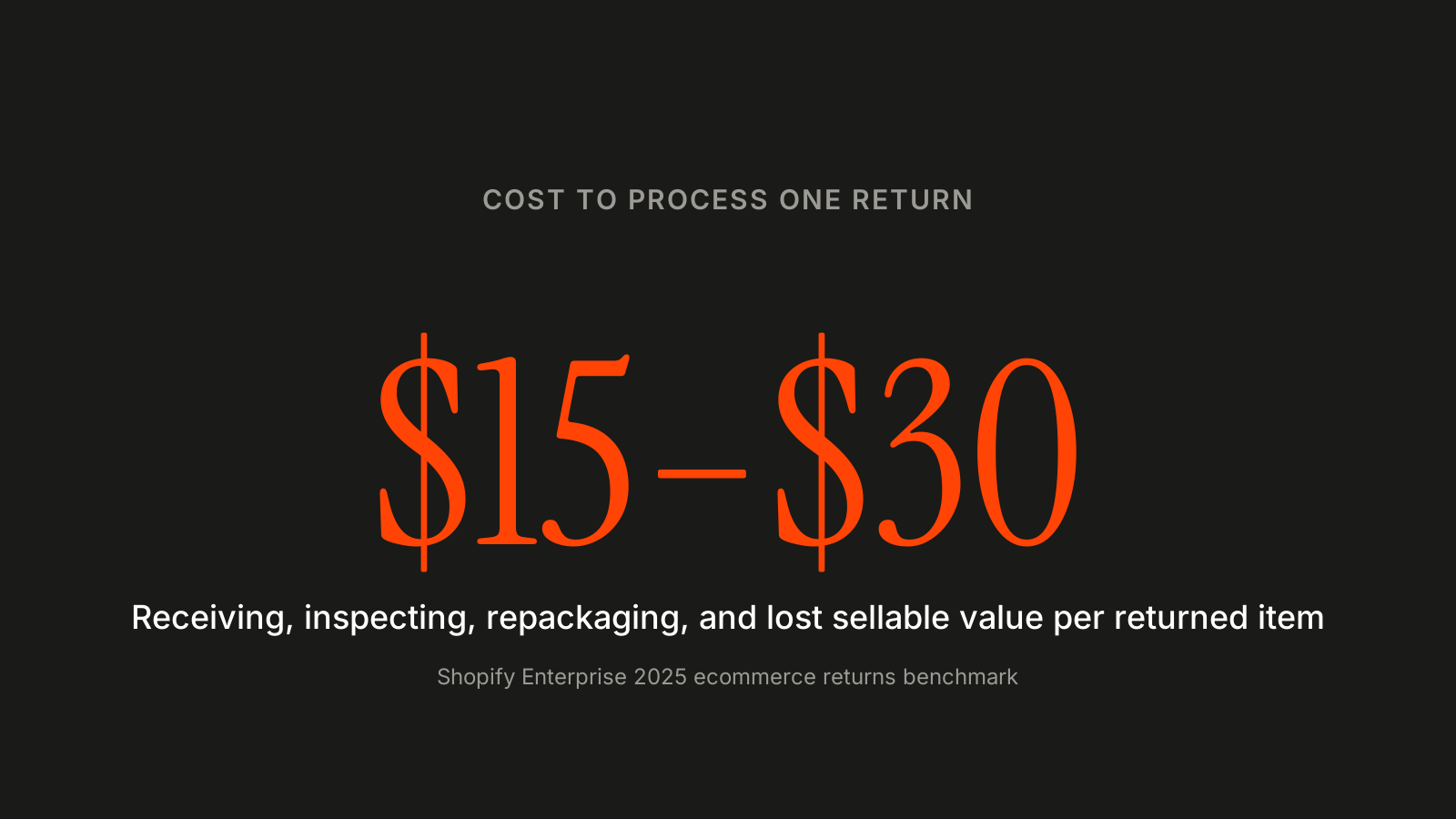
The cost a restocking fee is trying to recover. Source: Shopify Enterprise 2025 returns benchmark.
How Restocking Fees Work in Practice
Most restocking fees are written into the return policy as a percentage deducted at refund time. A customer returns a $200 item under a 15% restocking fee policy and receives $170 back, with the remaining $30 retained by the merchant to offset processing. The exact number a brand charges usually depends on the product category and the condition the item comes back in.
Standard merchandise that arrives unopened and resalable typically carries a lower fee, often in the 10% to 20% range. Custom-configured products, opened electronics, assembled furniture, and final-sale or clearance items tend to sit higher, sometimes 20% to 50%, because the path back to sellable inventory is longer or does not exist at all. Clear policy language is what keeps the fee from feeling like a surprise penalty, which is the fastest way to turn one return into a lost customer. A well-structured returns policy that drives growth states the fee, the categories it applies to, and the exceptions in plain language before checkout, not after the order ships.

Restocking fees scale with how hard the item is to resell. Figures vary by category and condition.
When a Restocking Fee Makes Sense, and When It Backfires
A restocking fee earns its place when the underlying return is genuinely costly and the buyer had clear information up front. High-ticket items with steep reconditioning costs, made-to-order goods, and categories with heavy serial-return behavior are reasonable places to hold the line. The fee here is doing real work: it offsets a cost the brand cannot avoid and nudges shoppers toward more deliberate purchases.
It backfires when it is applied broadly to ordinary returns. Shoppers increasingly treat an easy return experience as a condition of the first purchase, not a perk, and a blanket restocking fee reads as a penalty for trusting the brand. The economics of repeat purchasing rarely favor the fee: friction-free returns and conversion are closely linked, so a fee that recovers $20 today can quietly cost a multiple of that in lifetime value tomorrow.
The sharper move for most brands is not a universal fee but a smarter default. Steering returns toward exchanges and store credit keeps revenue in the business without charging the customer for the privilege of changing their mind, while fees stay reserved for the categories that truly need them.
How Modern Brands Handle Restocking Fees
The brands that get this right treat the restocking fee as one setting inside a larger returns strategy, not a standalone rule. Instead of taxing every return, they use policy logic to apply fees only where the economics demand it, and they make the low-cost path, an exchange or instant store credit, the easy default for everyone else.
That is the model platforms like Redo are built around. Rather than a flat fee on all returns, returns automation lets a brand set condition-based and category-based rules, so a final-sale item or an opened high-value product can carry a fee while a simple size swap flows straight to an instant exchange or store credit. It works because the operational reality supports it: analysis of reverse logistics finds a large share of standard returns can be processed straight through with automation, which is what makes selective, category-based fees practical instead of a blunt universal charge. The result is margin protection where it matters and a frictionless experience everywhere else.
Want to see this in action? If you are rethinking where fees help and where they quietly cost you customers, book a demo and we will walk through how condition-based returns rules and exchange-first defaults work together on real orders.
Key Insight
A restocking fee is a margin tool, not a returns strategy. Charge it where reconditioning is genuinely expensive, make exchanges and store credit the effortless default everywhere else, and the fee stops being a reason customers leave.
About Redo
Redo helps ecommerce brands turn post-purchase moments into lasting relationships.
Use AI-powered return flows, exchange-first logic, instant credit, and analytics to understand not just what customers bought, but why they come back.