In this article
June 1, 2026
-
7 min read
Solving Cross-Border Returns for Direct-from-Manufacturer Brands


Ecommerce has seen a quiet supply-chain shift over the last several years: more brands are fulfilling directly from the manufacturer line, often from factories in China or Vietnam, instead of routing inventory through a domestic warehouse first. The economics that drove the move are real. Direct fulfillment cuts working capital, speeds up turnaround, and recovers margin that domestic 3PLs used to consume.
The trade-off is less control. Shoppers expect a domestic experience even when the order is physically coming from another continent, and most brands have figured out how to deliver that on the way out: fast fulfillment, prepaid duties, branded tracking. The outbound side of the post-purchase experience has gotten remarkably good.
The returns side hasn't.
This post is about the specific gap direct-from-manufacturer brands inherit when they move fulfillment overseas: the return policy you need to close the international sale has nothing real behind it. We will walk through why brands made the move in the first place, why returns become the unsolved problem, and the network you can build or buy to close the loop.
Why ecommerce moved to direct fulfillment
The shift from "stock a US warehouse, then sell" to "ship from the source factory" did not happen because of one decision. It came from five compounding pressures, most of them economic:
Quicker turnaround. Inventory is not sitting in a forty-foot container on a transpacific route for two months before it becomes sellable. Product moves from the factory floor to the customer in days, not quarters. For brands testing new SKUs or chasing trends, that compression is the difference between selling out the season and missing it.
Double down on winners. Something is selling? You can buy more from the factory and list it on the website in a week, not three months. Direct-from-manufacturer makes the catalog responsive to actual demand rather than to a buyer's forecast from last fall.
Margin recovery. Cutting out domestic warehousing, 3PL handling fees, and inventory holding costs is meaningful. You are not paying to store, pick, and pack inventory twice (once at the import warehouse, again at fulfillment). The cost stack is shorter, and for many brands that is where the path to profitability runs.
Lower upfront capital. No full-container-load minimums to buy and ship upfront. Smaller, more frequent shipments mean less cash tied up in inventory you have not sold yet. For brands without venture funding, this is often the deciding factor.
Tariff optimization. Depending on order value, routing, and per-parcel versus bulk-import treatment, some brands have historically used direct-ship to manage duty exposure. The de minimis policy changes are reshaping that calculus, but the optimization rationale persists for many categories and price points.
Across all five, the underlying logic is the same: shorten the supply chain, get faster, lock up less capital. For the right kind of catalog and the right price point, the math works.
The return problem direct fulfillment creates
You cannot sell internationally without a return policy. That is not a customer-service nicety, it is a conversion requirement. Industry research consistently finds that a meaningful share of cross-border shoppers abandon their cart when the return policy is weak or unclear, and that confidence in a strong policy is one of the highest-leverage factors in international purchase decisions. According to Shopify Enterprise's 2025 returns benchmark, return-policy clarity is especially decisive in cross-border purchases, where the shopper is buying from a brand they have never touched and may not be able to find again.
When the shopper is in another country, ordering from a brand they have never bought from before, that gap widens further. No return policy, no sale.
So the brand offers one. And here is where the trap springs shut: where do those returns actually go?
If you are fulfilling direct from the manufacturer, or out of an overseas warehouse, this is not a footnote. You built your supply chain to push products out the door. None of it runs backward. A customer in Germany or Australia wants to send a unit back, and there is no address in their country set up to take it.
A related framing on the retention side: exchange rate is one of the highest-leverage post-purchase metrics a brand can optimize, and you cannot move it if your network cannot physically process returns in the first place. The promise on the product page only converts if the operations behind it exist.
The trap: there is nowhere good to send them
The instinct is to have the customer ship it back to wherever it came from. Two things go wrong, usually both at once.
The destination will not take it. Most direct-from-manufacturer setups and overseas warehouses are built purely for outbound. A factory makes product and ships it. It does not want a stream of customer parcels arriving to be received, inspected, graded, and fed back into stock. Overseas 3PLs handling forward orders usually will not touch reverse flow, or they will charge punishing per-unit handling for the privilege.
Cross-border return shipping is brutal. A single parcel moving internationally (niche carrier, customs paperwork, brokerage) often costs more than the item itself, sometimes with return duties on top. Multiplied across a few hundred returns, the margin that made international expansion worth doing is gone.
And the customer feels all of it: routed to a carrier with barely any drop-off locations nearby, spotty tracking, refunds that drag on for weeks.
The result is a return policy with nothing real behind it. The brand promised something on the product page that the supply chain cannot actually deliver. That is where conversion gains earned at checkout get given back in support tickets, refund disputes, and one-star reviews.
The other end of the same spectrum is also problematic. Brands that try to dodge the problem by refusing international returns entirely watch their reviews tank within a few hundred orders. The promise of a return policy is so central to international purchase confidence that taking it off the table is its own conversion problem.
Redo's solution: return warehouses in your shopper's backyard
This is the gap our in-region return warehouses fill. Instead of routing every return back across a border, Redo's international returns network gives your returns somewhere to land in-country.
Here is how it works:
Customers ship returns on local carriers, not cross-border ones. A customer in the UK drops their return with Royal Mail to a local Redo address. A customer in the EU uses an EU carrier. That one change (local first-mile instead of international first-mile) is where a huge chunk of the cost disappears. No more cross-border freight and brokerage on every single return.
Returns get received and processed at an in-country facility. The parcel hits our regional hub. Our team inspects it, grades it, and captures the disposition, so you get real visibility into condition and inventory instead of a black box across an ocean. Items can be graded A (resellable, like-new), B (resellable with discount), or C (not resellable), with you setting the thresholds and photo requirements.
From there you have two paths, and both protect your margin:
Refulfill in-country. A returned unit that grades as sellable does not need to come home at all. Reship it to the next customer in that same region. The return becomes your next local order and effectively pays for itself by covering outbound freight you would have spent anyway. No second border crossing, no duties, no waste. For brands whose international volume is meaningful, this is the strongest economic argument in the entire model.
Consolidate and bulk-ship across the border. When you do want inventory repatriated, the hub holds and consolidates returns, then moves them in a single freight shipment instead of hundreds of individual parcels. One customs event, one freight cost, instead of per-parcel international shipping on every unit. The broader playbook on consolidation strategy covers the disposition decisions and consolidation patterns in more depth.
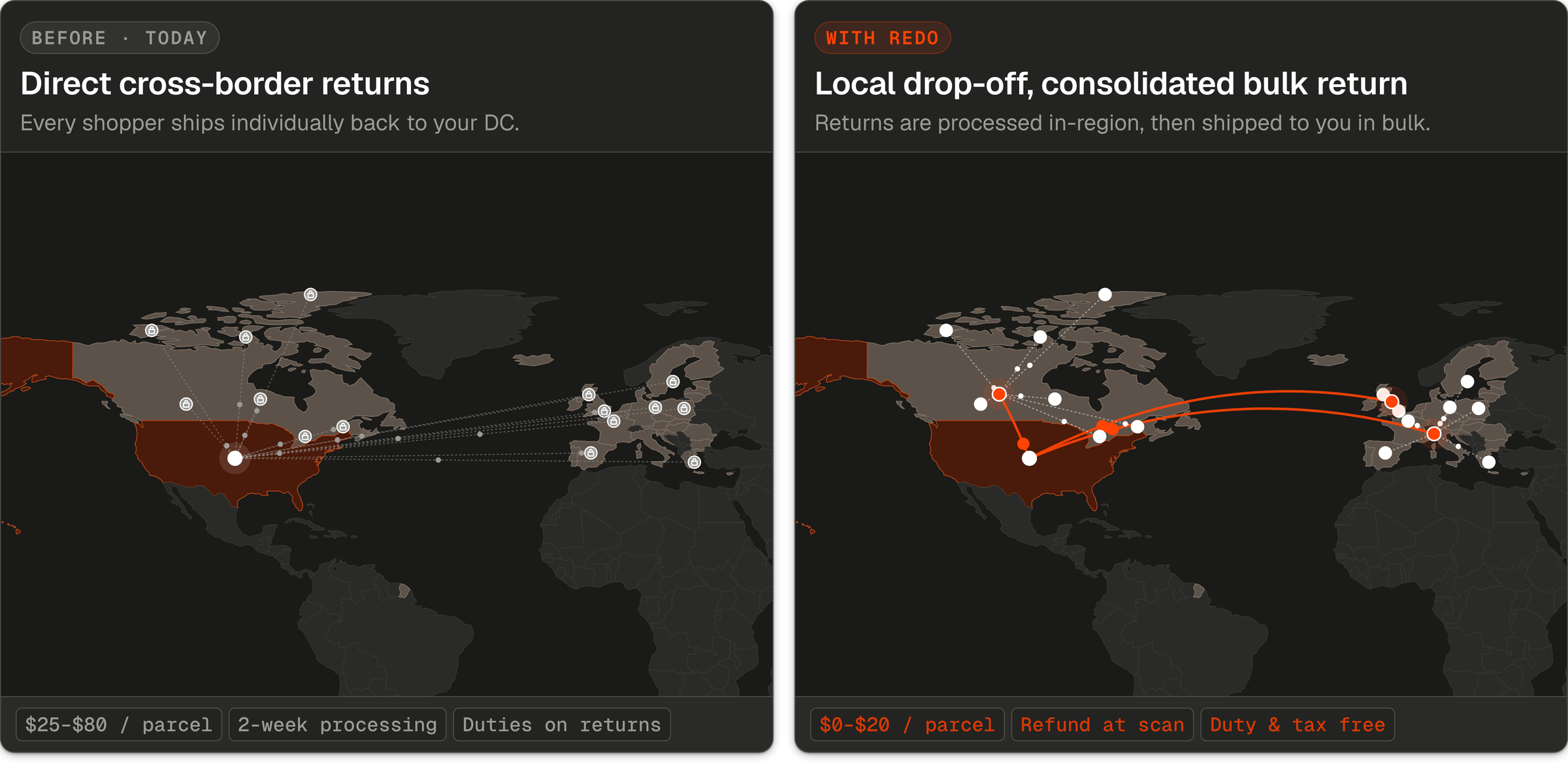
For the SKUs that are genuinely uneconomic (where the item is worth less than even local handling), Redo's returns platform rules engine can trigger a returnless refund automatically, so you are not paying to process something you would write off anyway.
The pattern repeats across five regions of coverage (United States, Canada, Netherlands, United Kingdom, Australia). Same flow, same operational discipline: local first-mile, regional processing, choice of refulfillment or consolidation, automated keep-it for the uneconomic tail. The brand keeps the customer-facing promise. The shipping economics no longer kill the unit economics.
A dropshipping-specific version of the same network (focused on smaller-scale operators and the "do I need a US warehouse" question) lives in our dropshipping returns post for readers in that segment. The underlying hub network is the same; the entry point is different.
The policy and the network are the same decision
The return policy wins you the international customer. The return network is what makes that promise affordable to keep. You cannot have one without the other, and until recently, the second half is the part nobody built for direct-from-manufacturer and overseas-fulfillment brands.
That is the whole point of in-region return warehouses: give your returns somewhere to go, let customers send them back the cheap local way, and turn what used to be a margin leak into either your next local sale or one clean shipment home.
The brands that solve this get to keep their international expansion economics intact. The brands that do not are paying transpacific freight on returns that never had a real path home, and watching the promise of a return policy erode the conversion gains it was supposed to create.
Ready to see what cross-border returns look like when they are solved end-to-end? Book a demo and we will walk through how Redo's regional hub network, rules engine, and consolidation pattern combine to turn your reverse logistics from a margin drag into a competitive advantage.
Key Insight
The return policy wins you the international customer. The return network is what makes that promise affordable to keep. Direct-from-manufacturer brands have built world-class outbound supply chains and inherited a returns problem none of their existing infrastructure was designed to solve. In-region return hubs close that gap, turning every returned unit into either the next local fulfillment or a single consolidated cross-border shipment. The brands that solve this keep their international expansion economics intact. The brands that do not are paying transpacific freight on returns that never had a real path home.
About Redo
Redo helps ecommerce brands turn post-purchase moments into lasting relationships.
Use AI-powered return flows, exchange-first logic, instant credit, and analytics to understand not just what customers bought, but why they come back.